
A parent sitting on the living room rug at eye level with their toddler, playing with wooden stacking cups and a board book

Wlonkworks. · Birth to three

Early Coach.

Everyday family routines, built for early communication

A deeply practical early speech guide for parents waiting on early intervention for their under-3 child—and for speech therapists stepping into home-based birth-to-three coaching.

For families waiting on services

You do not have to wait to start helping at home

Waiting lists and referral timelines can feel long when your toddler is struggling to be understood. Early Coach turns snacks, diaper changes, baths, and floor play into calm, doable communication strategies—no flashcards or therapy drills required.

For speech therapists new to EI

Built around how home visits really work

Moving from a clinic room to a family’s living room changes everything. Use Early Coach for parent-coaching language, natural-environment scenarios, and whole-child clinical cues across motor, sensory, feeding, and daily adaptive routines.

Multidisciplinary view

Communication never happens in isolation

In home-based early intervention, speech is woven into how a child moves, eats, regulates, and connects. Early Coach looks at the whole toddler across five linked areas.

01 · Core Focus

Communication & Language

Joint attention, gestures, sounds, single words, and two-way turns—built inside moments your child already cares about.

Seen inSnack choices, diaper changes, and shared board books

02 · Whole Child

Movement & Play

How posture, balance, and hands-on play open up new reasons to reach, point, imitate, and ask for more.

Seen inFloor play, stacking cups, and outdoor walks

03 · Whole Child

Sensory & Regulation

Reading comfort, energy, and sensory cues first—because a regulated, calm toddler is ready to connect and communicate.

Seen inBath transitions, quiet corners, and bedtime wind-down

04 · Whole Child

Feeding & Mealtime

Sitting together, exploring textures without pressure, and using natural pauses for requesting, refusing, and commenting.

Seen inHigh-chair snacks and family table routines

05 · Whole Child

Social-Emotional & Adaptive

Co-regulation, turn-taking, and everyday independence like helping with socks or wiping hands—where confidence grows.

Seen inGetting dressed, handwashing, and hellos & goodbyes

Real-life scenarios

One home routine, two ways to use it

Every guide in Early Coach pairs everyday home photography with step-by-step routines. Switch perspectives below to see how parents and new early intervention speech therapists use the same moment.

A parent holding two fruit choices at eye level while a toddler points and smiles from a high chairMealtime & Snack

12–30 months

Offering two visible choices at snack time

Your toddler is settled in the high chair and hungry for snack—one of the highest-motivation communication windows of the day.

What to try in two minutes

  1. Hold two familiar foods slightly apart at eye level and name each simply: “banana… or berries?”
  2. Pause for 5 full seconds—let your child look, reach, point, sign, or make a sound before handing it over.
  3. Honor any clear message immediately and model the word warmly: “Berries! You want berries.”

What to notice

A glance back and forth between the food and your face counts as real communication—not just spoken words.


A caregiver sitting on a soft bedroom rug helping a laughing toddler put on socks and a sage-green sweaterBath & Getting Dressed

15–36 months

Turning socks and sweaters into a predictable turn-taking game

Dressing happens every single day, making repeated words, body-part names, and playful anticipation effortless to weave in.

What to try in two minutes

  1. Sit face-to-face on the rug instead of dressing from behind so your child can watch your mouth and expressions.
  2. Use a short, repeatable script: “Sock on… foot! Push, push, push—all done!”
  3. Pause right before pulling the sweater over their head and wait for a giggle, eye contact, or “boo!”

What to notice

Anticipating the next step—lifting a foot or pulling the sweater—shows growing comprehension and turn-taking.

A parent playing on the living room floor with a toddler and wooden animals while a speech therapist coaches nearbyFloor Play & Coaching

Birth–36 months

Following the child’s lead on the living room rug

In home-based early intervention, the parent stays the child’s favorite play partner—and the therapist coaches the interaction.

What to try in two minutes

  1. Skip the toy bag quiz—sit beside whatever your child already picked up and copy their action.
  2. Trade questions (“What color is that?”) for short comments and fun sounds (“Cow! Moo… walk, walk, walk”).
  3. Wait after each turn so your toddler has space to lead the next move.

What to notice

When you comment instead of quizzing, toddlers often stay engaged longer and try more spontaneous sounds.

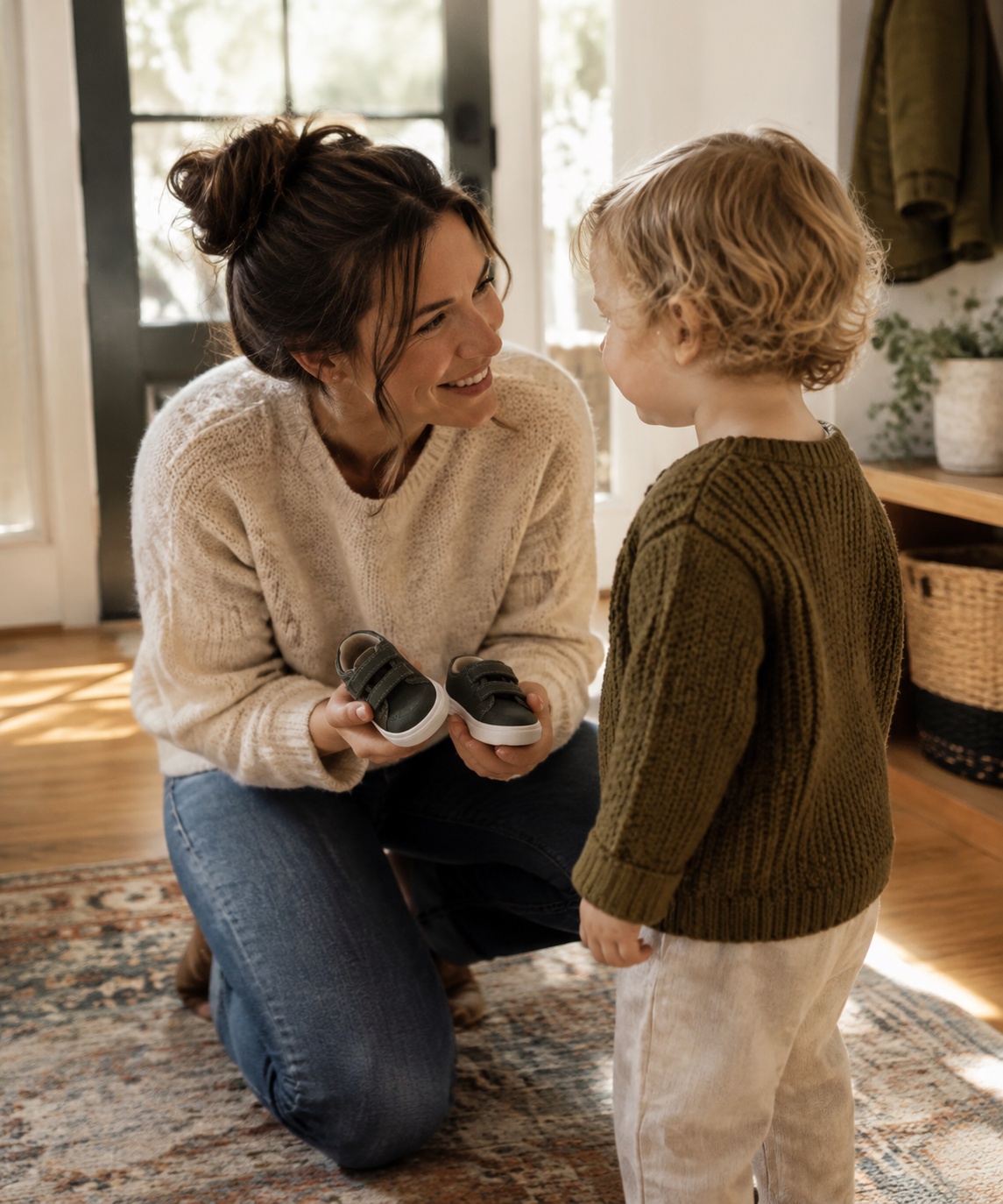
A parent kneeling at eye level in a sunlit entryway holding two small shoes while connecting warmly with a toddlerTransitions & OutingsFamily Pass

14–36 months

Turning stressful doorway transitions into predictable cues

Leaving the house is one of the hardest daily flashpoints. Predictable two-step cues lower sensory overwhelm and invite cooperation.

What to try in two minutes

  1. Kneel at eye level two minutes before leaving and hold up the transition object: “Shoes on… then bye-bye car.”

Includes sensory meltdowns troubleshooting + visual cue script

Steps 2–3 and the what to notice are included in Family Pass.

A parent smiling and pointing at apples at eye level with a toddler sitting in a grocery cart seatErrands & CommunityFamily Pass

15–36 months

Building pointing and commenting in the grocery produce aisle

Errands are packed with colorful, novel objects—making the produce aisle a natural stage for shared attention without buying a single toy.

What to try in two minutes

  1. Slow down for 60 seconds in produce and point to what your toddler notices: “Look! Big apple… red!”

Includes 10-word grocery core vocabulary list + cart-fidget tips

Steps 2–3 and the what to notice are included in Family Pass.

A parent and toddler in cotton pajamas sitting together in a bedroom armchair reading a board book by warm lamp lightBedtime & IFSP CarryoverClinician Pro

Birth–36 months

Coaching calm board-book wind-down & IFSP carryover scripts

Evening book time gives caregivers a quiet, repeatable ritual—and gives new EI clinicians a clear template for coaching without taking over.

What to try in two minutes

  1. Skip reading every printed word—point to one picture per page and wait for your child to tap, turn, or make a sound.

Includes verbatim caregiver coaching script + sample IFSP outcome

Steps 2–3 and the what to notice are included in Clinician Pro.

Simple freemium access

Start free today, unlock depth when you need it

Every family waiting for early intervention gets core daily routines free forever. Upgrade for sensory troubleshooting, IFSP prep tools, or clinician coaching scripts.

Parents & New Clinicians

Free Waitlist Bridge

Immediate, practical home strategies while you wait for services or start home visits.

$0

no card needed

  • 3 core daily routine guides (Mealtime, Dressing, Floor Play)
  • Both Parent & New EI Therapist perspective views
  • Whole-child multidisciplinary framework overview
  • Full access to Wlonkworks blog guides & IDEA Part C links
Current view (Free)

For Parents & Caregivers

Most popular

Family Routine Pass

Deep routine library and sensory workarounds tailored for waiting families.

$39

one-time 6-month waitlist pass

  • 25+ everyday & community routine scenarios (transitions, errands, bedtime)
  • Sensory & motor “What if…” troubleshooting adaptations
  • Custom Family Routine Planner for your child’s cues
  • IFSP Readiness Summary PDF to bring to your evaluation

For Early Intervention SLPs

Best value

Clinician Pro

Caregiver coaching scripts, handouts, and IFSP tools built for home visits.

$99

per year (save 45%)

  • Everything in Family Routine Pass
  • Verbatim caregiver coaching scripts for tricky home visits
  • Printable, jargon-free family routine handouts to leave behind
  • Functional IFSP goal bank & OT/PT joint-visit checklists